
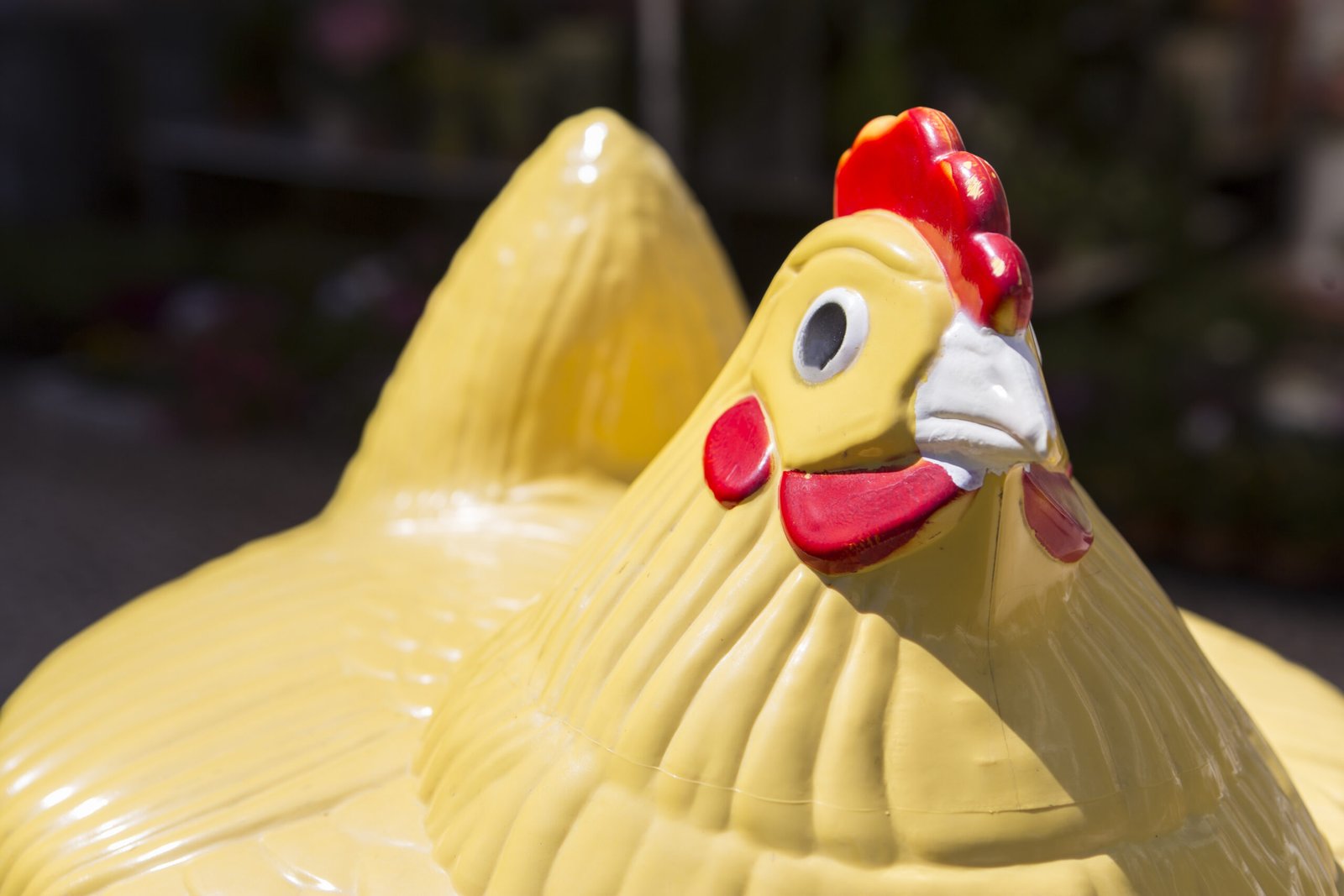
In April 2026, a code enforcement officer in a small Maine beach town mailed a “Notice of Violation” to a breakfast restaurant on Route 1. Four months later, tin roosters were showing up on lawns from Kennebunk to New Zealand, a Facebook page had logged more than a hundred bird locations across New England, and a six-year-old girl with autism had become the unlikely center of what her adoptive father now calls “the Rooster Movement.” No communications firm planned it. No nonprofit issued a press release to kick it off. That’s precisely what makes it worth studying.
A comfort object, a restaurant logo, and a $450 fine
Dave and Sara LeBlanc own The Omelette Factory, a breakfast spot in Ogunquit, Maine, attached to the house where they live with their adopted daughter, Pyper. She came to them as a foster placement with a stuffed rooster among her belongings, and the animal stuck. According to the Associated Press, the collection began after a trip to Tractor Supply, where Pyper spotted a large metal rooster sculpture and asked her father what it was saying to her. It grew from there to more than two dozen birds, rotated seasonally on the family’s lawn. Pyper hides behind one every morning while she waits for the school bus — a ritual her parents say helps her regulate her emotions during a hard transition.
Beverley Cush Evans, a professor of special education at Lesley University, told the AP that comfort objects like this are a familiar tool in autism therapy, used to ease transitions and provide a sense of the familiar in unfamiliar moments. The roosters were doing real, unglamorous, daily work.
The trouble started when the LeBlancs put a rooster on their restaurant’s shirts and merchandise, treating it as something like a family crest. The town of Ogunquit saw the lawn statues differently: as unpermitted advertising for the attached business. A code enforcement officer, Tyler McOsker, fined the couple $450 and ordered them to remove “all unpermitted signage, including but not limited to rooster statues.” Dave LeBlanc’s response to the AP became the quote that traveled with the story everywhere it went: roosters, he pointed out, don’t lay eggs, so calling them egg-related advertising didn’t hold up. The family initially refused to comply.
From lawn ornament to movement
What happened next is the part that matters for anyone who works in nonprofit or NGO communications. A neighbor, Kathy Kotakis, put a rooster on her own property in solidarity. Then another neighbor did. Then a motel owner in nearby Wells, Hetal Patel, who has a relative with autism, drove to New Hampshire because the local stores had sold out, and told a reporter people were honking in support as she set hers up. A supporter in New Zealand mailed in photos of his own kids next to a rooster in their yard.
The LeBlancs eventually reached an agreement with the town: they could keep two roosters at their own address, and gave the rest away to be “fostered” by friends, neighbors, and strangers, starting with a man named Sam up the road. Rather than shrink the story, giving the roosters away multiplied it — each relocated bird became a new location on a map the family started keeping, and a new person willing to explain, to anyone who asked, why there was a six-foot tin chicken on their lawn. By late July, Maine Public counted at least 100 roosters across every New England state. The Facebook page, “The Roosters of Ogunquit,” passed 5,000 followers within weeks. AP wire coverage got picked up by ABC News, Fortune, the Boston Globe, WBUR, and dozens of local affiliates. Some birds got names — one is called Cluck Norris.
Michelle Guffee, a Board Certified Behavior Analyst who runs New Horizons Education Group in Florida, told the site Brick Tides that she saw something bigger than a zoning dispute in the community’s response — an argument, made in yard art rather than in words, for including autistic kids and their families rather than just tolerating them. The LeBlancs now describe the project in those terms too. Dave LeBlanc told Maine Public the roosters had become “an amazing wildfire that can raise money and benefit” kids who otherwise don’t have a public voice, and the family is looking into setting up a formal foundation.
Why this story moved, and why most awareness campaigns don’t
Autism organizations spend real budget trying to manufacture the kind of reach the LeBlancs got by accident. The Ogunquit story is worth picking apart for the elements that made it travel, because none of them required a marketing plan.
| Element | Why it worked |
|---|---|
| A visual, repeatable object | A six-foot tin rooster photographs well, is instantly recognizable, and is cheap enough for a stranger to copy. Awareness ribbons and hashtags ask for belief; a rooster on a lawn asks for nothing but a trip to Tractor Supply. |
| A genuine underdog | Small family business versus a code enforcement officer is a familiar shape, and it doesn’t require the audience to take a side on autism itself before they take a side on fairness. |
| A specific child, not a statistic | The CDC estimates roughly 1 in 31 eight-year-olds in the U.S. has autism spectrum disorder. That statistic did not spread the story. Pyper hiding in the tail feathers while she waits for the bus did. |
| A low-cost way to participate | Buying or building a rooster is a real, visible act of solidarity that costs a stranger in Wells or Kennebunk very little, and gives them something to show for it. |
| Local press first | AP’s regional wire desk and Maine Public covered it before the national outlets did, which gave the story a layer of local credibility — actual neighbors, on the record — before it reached readers who had never heard of Ogunquit. |
None of that is a knock on planned campaigns. It’s a reminder of what they’re competing with. A nonprofit that spends a quarter’s budget on a symbol nobody can copy for free, fronted by a composite “affected family” instead of a specific one, is starting several steps behind a restaurant owner and his daughter’s tin roosters.
The harder lesson: what happens after it works
The instructive part of this story isn’t really the going-viral. It’s what the LeBlancs have had to figure out since, largely in public and mostly without help. That’s the part that maps directly onto how NGOs handle a story that outgrows its original scope.
Decide what the story is actually about, and say so before someone else decides for you. For a few weeks, the Ogunquit story could plausibly have stayed a fight about municipal overreach and small-business signage rules — a fine target for local outrage that would have burned out inside a news cycle. The LeBlancs, with help from neighbors like Kotakis explicitly naming autism and foster adoption as the point, pulled it back toward the subject that gave it staying power. Sara LeBlanc made the same move on the record with Maine Public, pointing out that a town that flies Pride flags and talks about inclusion ought to be able to accommodate more than physical disability in its codes. That’s a communications instinct many campaigns lack: naming the actual stakes clearly enough that reporters, and the public, don’t have to guess or default to the easier, angrier framing.
Bring in a credentialed third party before critics can dismiss the story as sentimental. Quoting a Lesley University special-education professor and a Board Certified Behavior Analyst did real work here. It moved the story from “a family really likes chickens” to a grounded, if informal, statement about comfort objects and community inclusion — the kind of framing an actual autism-focused nonprofit would normally have to build over months of relationship work with clinicians and researchers.
Resist scope creep, even when the attention is flattering. A story this size invites merchandise offers, media requests from outlets with no interest in autism, and pressure to turn a spontaneous, community-built symbol into a product. The LeBlancs’ choice to give roosters away rather than sell them, and to build a map instead of a storefront, kept the campaign’s center of gravity on Pyper and on other kids like her rather than on the roosters as a brand. Any NGO managing an unplanned viral moment faces the identical fork: monetize fast while attention is high, or protect the story’s credibility and monetize slower and smaller. The two paths rarely both stay open for long.
Formalize governance before the informal structure buckles under its own success. A hundred birds spread across six states, a Facebook group with thousands of members, and a family fielding daily media calls is, functionally, an organization — it just doesn’t have a board, a bank account, or a conflict-of-interest policy yet. The LeBlancs’ move toward establishing a foundation is the unglamorous but necessary next step that separates a viral moment that fades into an old news article from one that becomes a lasting resource. Established NGOs that get pulled into a sudden surge of public attention — after a natural disaster, a wrongful denial of services, an incident that captures public sympathy — face the same task on a compressed timeline: get the accounting, the intake process, and the decision-making structure solid enough to survive the scrutiny that virality brings with it.
Let the injustice be the hook, not the whole story. The code enforcement dispute got the AP’s attention. It is not, on its own, why the story kept spreading for months after the town and the LeBlancs reached an agreement. Injustice narratives are excellent at generating a first wave of coverage and outrage; they are much weaker at sustaining a movement, because outrage has a short half-life and the resolution of a dispute usually kills the news hook. What kept the Ogunquit story alive past its own resolution was the reframe toward something durable — autism acceptance, fostering and adopting kids with disabilities — that didn’t depend on the town remaining the villain. Communicators chasing a righteous-anger story should plan for its ending on day one: what does this become once the specific wrong has been addressed, or once the outlet that broke it moves on to the next thing?
The takeaway for people who do this for a living
Charities and NGOs generally can’t manufacture a Pyper LeBlanc or a $450 fine on cue, and shouldn’t try to fake either one. What they can take from Ogunquit is a more honest set of questions to ask about their own campaigns: Is there something here a stranger can copy for free? Is the person at the center specific enough to be a person rather than a statistic? And if this works far better than planned, is there a structure ready to receive that attention responsibly, rather than a scramble to build one after the fact? The LeBlancs are building that structure now, in public, a few weeks behind the story itself. Most organizations get the chance to build it first.
Sources
- Giant metal roosters spread autism acceptance in Maine after town zoning spat, Associated Press via WFMZ
- Ogunquit vs. lawn roosters: How a zoning issue became a viral autism campaign, The Boston Globe
- Ogunquit residents set up tin roosters around town to support family, WGME
- Why did a Maine town fine a family that put up a giant metal rooster to support their daughter with autism?, Fortune
- Ogunquit’s spat over six-foot-tall roosters gets national attention, Maine Public
- Spat over 6-foot-tall roosters in seaside Maine gets national attention, WBUR
- The Roosters of Ogunquit, Brick Tides
- Authorities fined a family over an autistic 6-year-old’s ‘illegal’ rooster displays, Upworthy